The Playground and The Graveyard: Tips on Accidentally Writing A Novel
On getting started, a place to play, and where I bury my darlings.

I’m endlessly fascinated by the little tips and tricks and rituals of the novel writer. I didn’t actually mean to write a novel. But when I happened upon an idea that outsized the part of my brain that thinks about spec-ing out TV pilots and one-pagers and pitch scripts—to say nothing of the part of my soul that was so tired of being told ‘no’ by streaming executives after years of labor1—I started quietly writing fiction.
It grew into a novel.

When I say I started ‘quietly’ what I really mean is secretly. A contradiction: I am so chatty, a consummate over-sharer/confessor2 , but Goddess also blessed me with a Scorpio rising, which occasionally allows to me keep a secret—even from myself, it turns out. I think in part, so as not to spook myself out, I tricked myself at first and told myself I wasn’t writing a novel, and broke the story like I would a TV pilot.
And when you start in on an idea for TV you’re never just breaking a pilot story. That actually might come last. First, you’re thinking about a character, the fucked up thing that starts their journey, you’re coming up with a world, and a ton of scenes and secrets, conflicts to move an ensemble across at least one whole season. All the same stuff, it turns out, you need to start writing a novel.
Still, I wish I could locate the moment in time where I allowed myself to accept I was writing a book. I think it might have been more what relationship experts call ‘sliding, not deciding’ — like when you slowly move in with a guy you’re dating who’s just OK at sex because you’re sick of driving all the way to Santa Monica.
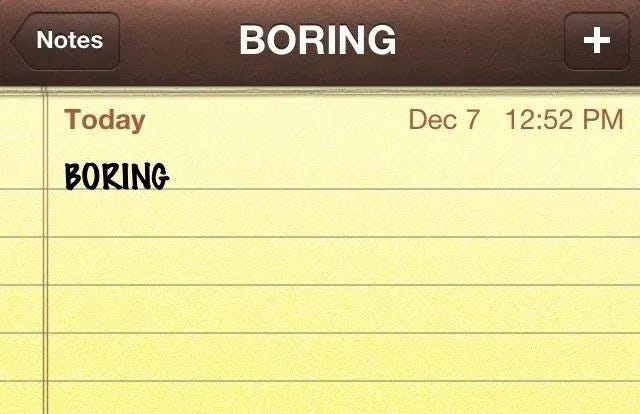
What I do know about my process is that, like all my creative endeavors, this book was born on the factory floor of my Notes app. Yes, I am one of these sad aging millennials who’s been writing themselves little chaotic notes and pieces of weird personal essays and to do lists in the Notes app pretty much since it looked like this:
I know people use fancy software like Scrivener with all its bells and whistles and hidey-holes for notes and outlines—I even spent a lot of time writing on a program called Dabble Writer that I liked a lot. But ultimately, when I started working with an editor, we were back on my native GoogleDocs, and as buggy and basic as it is, it gets the job done, it’s free, and I’ve yet to find a better system for tackling notes than leaving comments and track changes.
But, wait, I was talking about Notes app!
All I’m trying to say is that every single project, for me, starts in the Notes app. I know a project is starting to get real when I create a note and start filling it with ideas while I’m in bed3, in line at the grocery store, hiding in the bathroom at a restaurant.
I do it in the notes app, maybe you’re better and do it in an actual pen-and-paper journal, but I’ll call this important part of the creative process: The Playground.
There’s absolutely no rules in the Notes app/playground as far as I’m concerned. Only that each project or idea gets its own dedicated note, and that the note gets to be as unruly and overgrown as I’d like it to be. I NEVER press delete in the Notes app, instead opting to strike out any ideas that I’ve executed, meaning they’ve ended up in a draft and graduated from the purgatory of the playground and now must stand the test of the ruthless editing that’ll come later. Sometimes, when an idea no longer strikes joy or has become outdated, I put it in italics. Things I really want to make sure I don’t forget and feel like I’m liable to overlook are bolded.
Here’s what the Playground for my current WIP looks like:
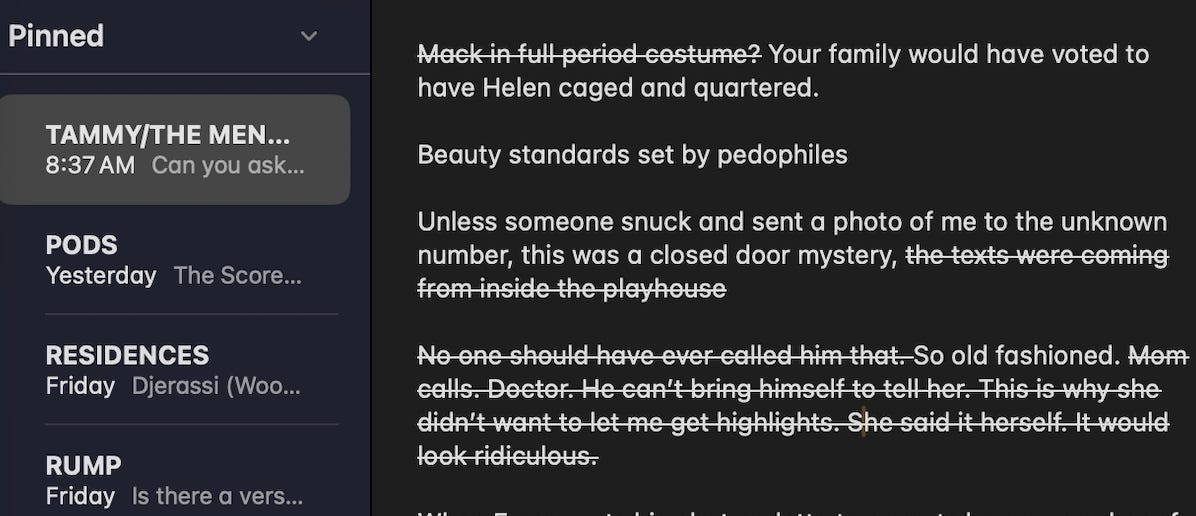
Most everything in the Playground was recorded in a moment of inspiration: I got the flare of a strong idea, a conviction about how something in the novel needs to go, an image or a joke, a scene, a sentence, the shape of the next part of the story, a map4.
Whenever I get stuck while writing, I return to the playground and scroll around a bit to see if anything will help in that moment. It’s like shopping the eccentric wares of Inspired Me to see if I can shoplift anything that’ll help Stuck Me get inspired again.
Maybe all I need is to remember that at some point I wanted to write a line or joke about ‘beauty standards set by pedophiles,’ and I’ll lay down some track to get there. Shocker: as you can see, that hasn’t happened yet. But I was very thankful recently to Inspired Me for beating out a short scene in which the protagonist’s mom calls—the beats of which I used and then crossed out, (minus one concept, ‘so old fashioned,’ which is shorthand for an idea that didn’t make it into this draft of that scene, and which I’ll keep un-struck in case it proves useful in revision.5)
I once read that Ann Patchett doesn’t write down a single creative idea, instead trusting if an idea is good enough she’ll remember it, or it’ll show up in the writing on its own. I bolded that idea for a reason—when I heard this, it stopped me in my tracks. It’s so fucking bold! Not being able to jot down the perfectly formed sentence that arrived while I was bickering with myself in the shower? I don’t think I’d survive.
But Ann is of course one of the greatest minds we have, and I think I understand the appeal and point of this. Becoming obsessed and possessed by a novel (or any creative idea) is such a pleasure, and sometimes I’ll get a false sense of productivity by jotting down a note alone, or scrolling through the playground as a means of ‘productive procrastination’, where sitting and writing from scratch without chatter from even my past self would be a far more useful, mindful, and boundaried way to write.
Recently another literary rockstar whose work and writing advice I admire very much, Catherine Lacey, wrote about how she’s logging hours working on her latest novel:

It made me realize I have so few actual lucid memories writing the novel I am about to go out on sub with! I have far more memories of editing it, wrestling with it, executing notes on it. But how many hours, I wonder, and when exactly did I write this book?
All I know is that it started in the Notes app, and — I just gasped aloud:
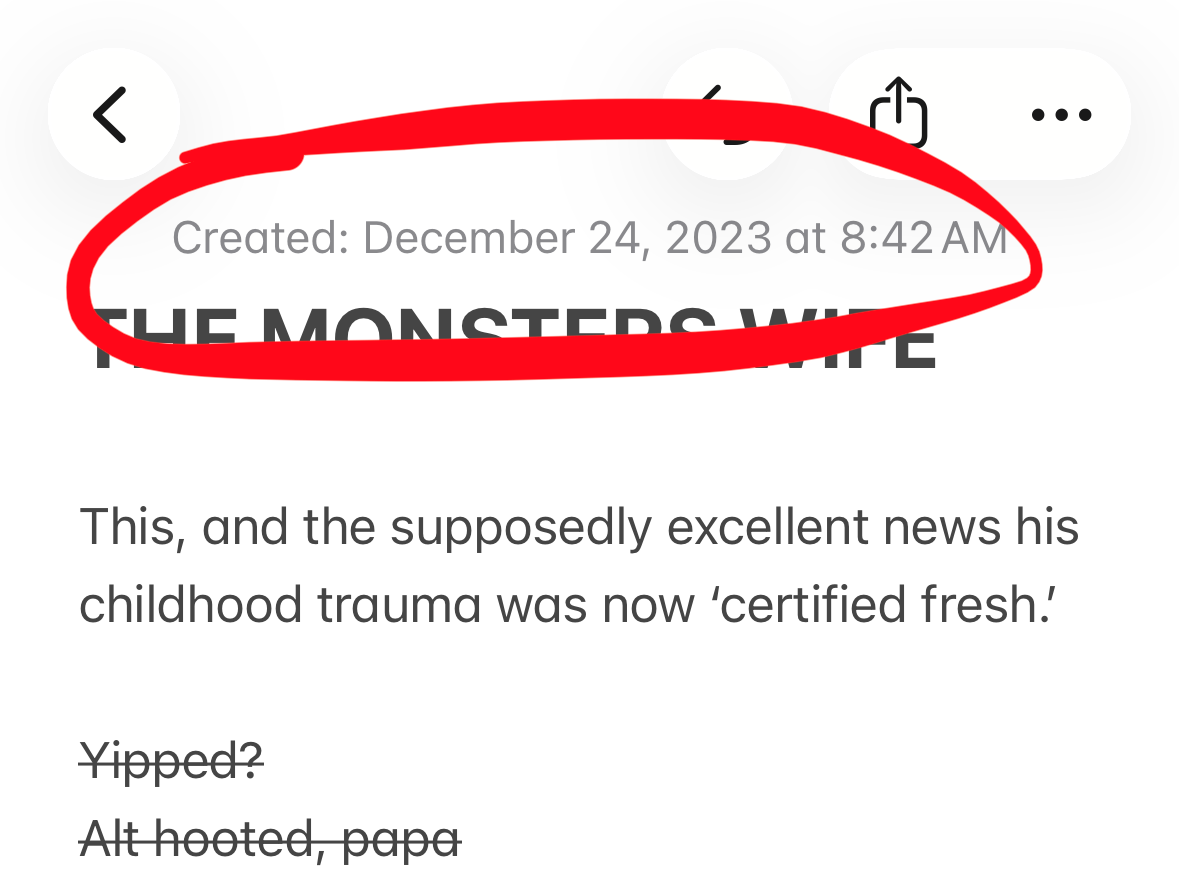
Did you guys know that if you tap the date at the top of any note, it will tell you its birthday? That’s insane. Well—we’ve concluded, then, with an answer to a mystery: my book was born, outrageously, on the morning of Christmas Eve, 2023.
God, it makes perfect sense the book is a Capricorn. Now that I have the book’s birthdate and time, maybe I’ll do its full chart and astrological reading in another post.
Speaking of other posts: this was supposed to be about Playgrounds and Graveyards, but I think Playgrounds have given me more than enough to chew on, and I worry I’m going long for the 20-something of you (thank you for being here, truly).
Perhaps next time I’ll talk about the graveyard I keep for each project—a place where I bury the huge blocks of text that get slain, and how and when I’ve returned to the graveyard to exhume them (spoiler: as in real life/true crime, it’s very rare).
I’d love to hear from you in the comments: How and where do you play and record all your sprawling ideas before and while you write? How do you keep track of it all?
Okay, it’s so crazy that I’m doing this, I hope no one is mad at me, I love you guys,
Dan
That, impossibly, being one of the BETTER outcomes these days.
See: OCD, Catholicism. And really, what’s the difference?
With apologies to my husband.
This is different than outlining, which, because I am a TV writer I seem incapable of doing anywhere else than on a white board.
It probably won’t. I’m a hoarder of ideas, I think I have a scarcity complex when it comes to tossing anything out. Marie Kondo, can you please write a book on the life-changing magic of digital tidying up?
I am recording your novel’s birthday in my Notes app. —Angie
I didn't realize until you made me answer this question that probably 98 percent of my ideas I just keep floating around in my brain. And then that moment happens where the words demand to heard and all I can do is try to buckle up in time.